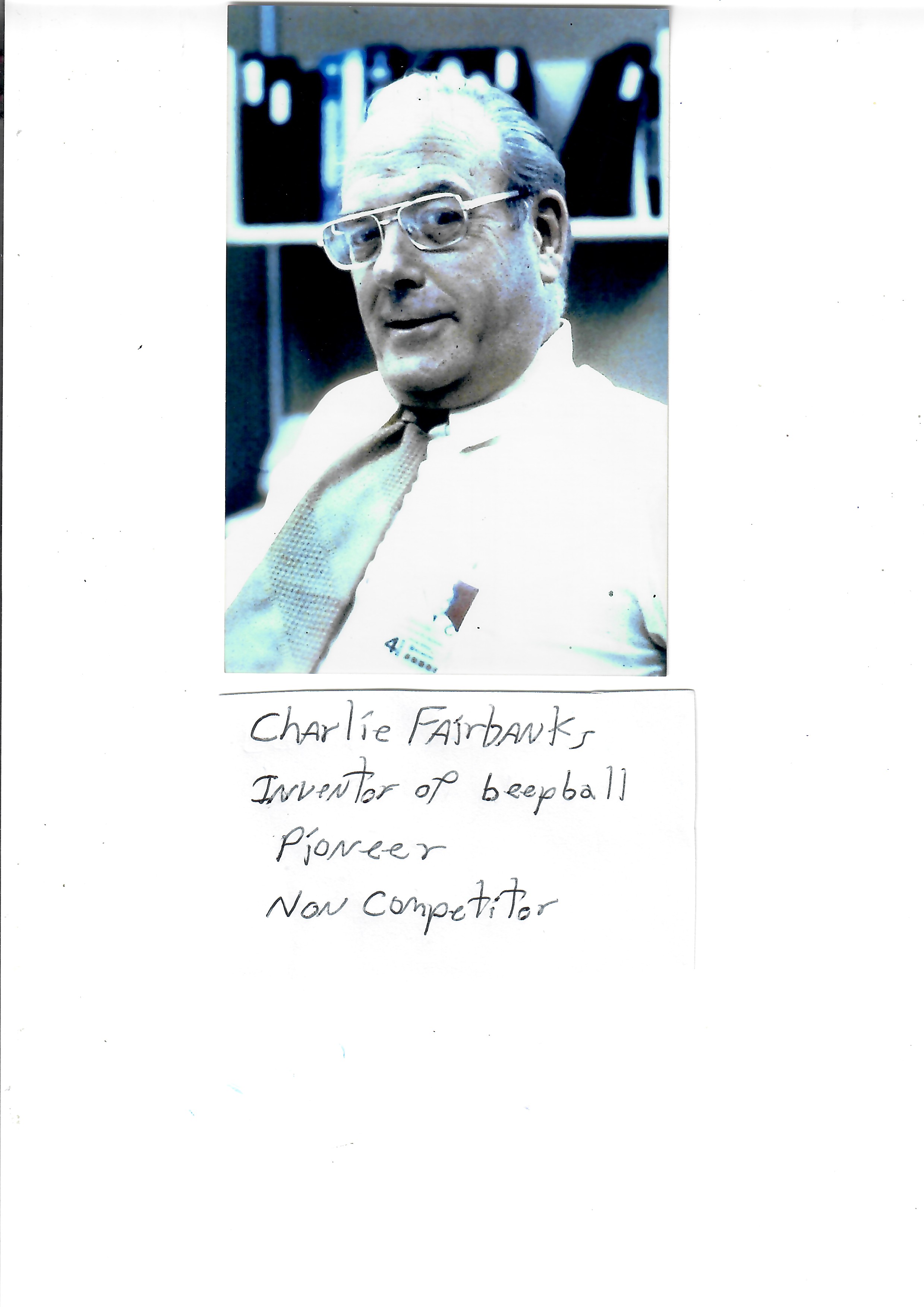
Charles Fairbanks
Overview
Charles Fairbanks is rightly known as the “Father of Beep Baseball.” Inducted into the NBBA Hall of Fame in 1999 as a non-competitor, Fairbanks’ 1960s invention of the audio ball laid the foundation for the sport that would later become the National Beep Baseball Association.
Born June 20, 1924, and passing on April 17, 2007, Fairbanks was an engineer for Mountain Bell in Colorado. During a visit to the Colorado Springs School for the Deaf and Blind, he learned that visually impaired children had no practical way to play ball. A traditional bell inside a ball would go silent once it stopped rolling. Determined to solve the problem, he began experimenting in the cellar of his Denver home.
Through trial and error, cutting apart softballs and testing different components, he developed a working audio ball using a telephone ringer housed inside a regulation sized ball. His wife Violet helped sew the early prototypes together. What began as a playground solution for schoolchildren would ultimately change lives nationwide.
From Playground to World Series
At the time, Fairbanks never imagined the long term impact of his invention. As he later told a Houston Chronicle reporter during the 1991 NBBA World Series, “I knew the children at the school needed it, but I never thought it would come this far.”
Remarkably, 1991 marked the first time he ever attended a beep baseball game. Welcomed to Houston by the NBBA, the Telephone Pioneers, and players from across the country, he threw out a ceremonial first pitch and was honored at the banquet. Seeing the athleticism, competition, and camaraderie of the World Series was, in his words, humbling. He was astonished that twenty balls might be used in a single six inning game, and those who knew him joked that he was likely already thinking about how to make them more durable.
A Spirit of Service
Fairbanks served in the Army Air Corps during World War II, married Violet Stone in 1952, and built a long career as an engineer before retiring in 1984. He was a lifelong volunteer, educator, and mentor. Those close to him described him as serious, intelligent, caring, and endlessly willing to help. His personal motto reflected his practical ingenuity: “If it can’t be fixed, you don’t need it.” When asked how he was doing, he often replied, “I am great, bordering on magnificent.”
Importantly, when his work on the audio ball passed to others, he made one request. No one should profit from it. To this day, the Telephone Pioneers continue to produce the balls at cost through volunteer labor, honoring that commitment.
Lasting Legacy
In 1975, when John Ross and other innovators received improved audio balls from the Telephone Pioneers, the final piece was in place for the formation of the NBBA. Fairbanks’ invention made competitive beep baseball possible. Without a reliable ball, there could be no Minnesota Rules, no World Series, and no national league.
In 2015, Fairbanks’ daughter Deb addressed the NBBA World Series and reflected on how a simple idea meant for a handful of schoolchildren had grown into a national championship sport. She spoke of the pride, family atmosphere, and athletic excellence she witnessed among players. Her father never sought recognition. His reward was seeing children smile and knowing that his idea allowed them to play.
Charles Fairbanks did more than invent a ball. He opened the door for blind athletes to step onto the field with dignity, competition, and pride. Every time the familiar beep sounds across a beep baseball field, his legacy lives on.