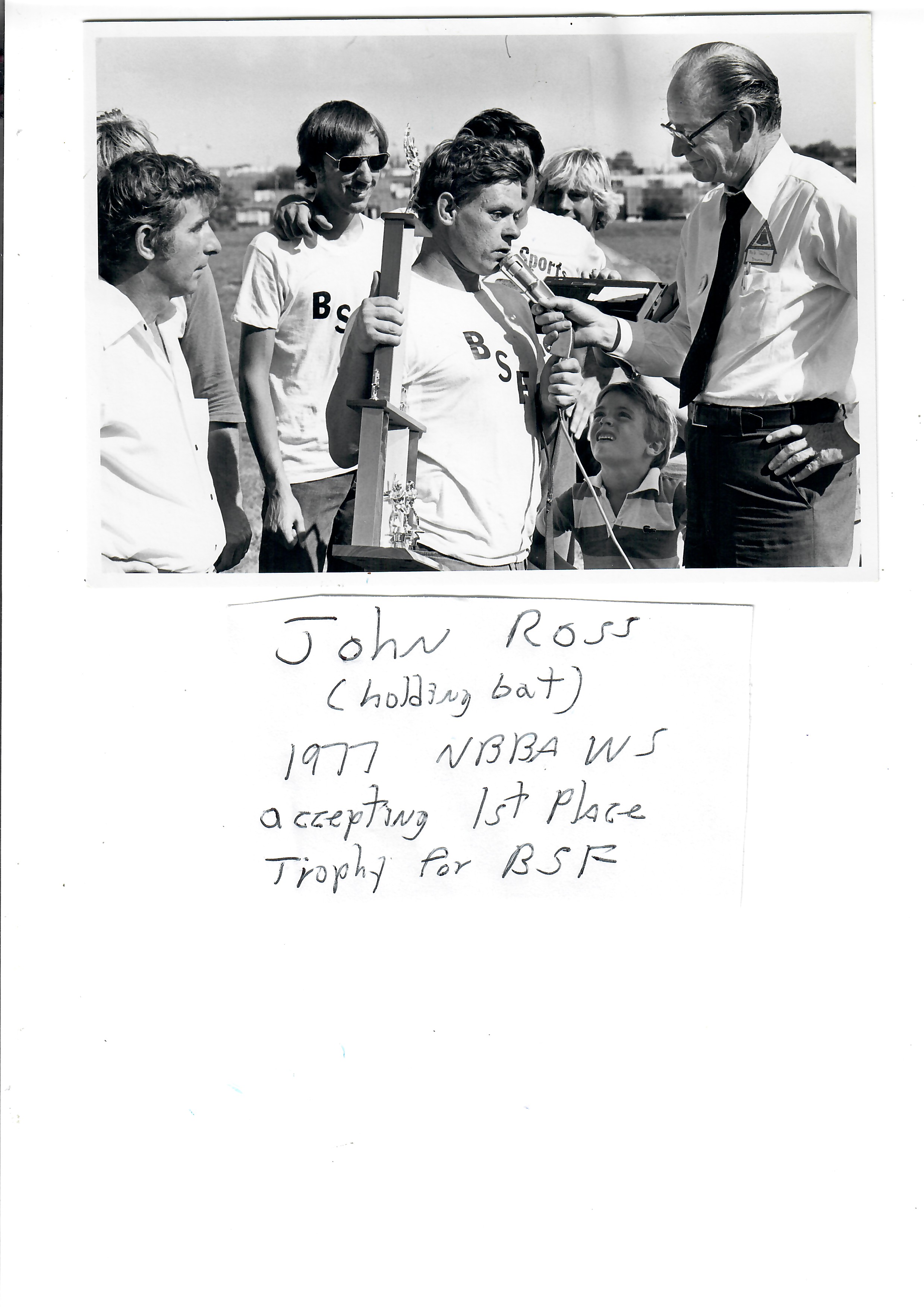
John Ross
Career Overview
John Ross is widely recognized as the “Father of Modern Beep Baseball.” A 1999 Hall of Fame inductee, Ross played from 1976 through 1992 with the Minneapolis Braille Sports Foundation and helped shape the structure, rules, and national growth of the NBBA.
Serving on the NBBA Board of Directors from 1976 to 1986, he was both a competitor and a driving force behind the league’s early identity. His leadership extended far beyond the field, influencing how the sport would be played for generations.
World Series Presence
Ross was a steady contributor during the NBBA’s formative years and earned multiple World Series All-Star selections.
- World Series All-Star, St. Paul, MN
- World Series All-Star, Dallas, TX
- World Series All-Star, Minneapolis, MN
As a member of Minneapolis BSF, he helped lead one of the league’s first powerhouse teams. BSF captured three of the first four NBBA World Series titles in 1977, 1978, and 1979, and remained a consistent contender through 1992.
Building Modern Beep Baseball
In the summer of 1975, Ross worked alongside Dennis Huberty and others to redesign the early version of beep baseball into a faster, more competitive game. With support from the Telephone Pioneers, they experimented with rule changes that introduced 90 foot baselines, blindfold requirements for partially sighted players, fielding responsibilities, and the now iconic “ready, pitch” voice cue from a sighted pitcher.
These innovations became known as the “Minnesota Rules.” They formed the foundation of the NBBA rulebook and transformed beep baseball into a legitimate national sport. In March of 1976, Ross helped organize the Chicago meeting that formally established the National Beep Baseball Association and set the stage for the first World Series that September in St. Paul.
Advocate and Pioneer
Ross founded Feeling Sports Magazine in 1975, the first sports publication dedicated to athletes who are blind or visually impaired. Published in Braille, large print, and on tape, the magazine became a vital communication tool during the sport’s early growth and helped spread the word about the NBBA nationwide.
A gifted athlete in his own right, Ross had previously been a state wrestling champion, wrestled at the University of Minnesota, and competed in multiple sports after losing his vision. His life reflected the belief that blindness was not a limitation but a challenge to be met.
In 1981, he became the first recipient of the Jim Quinn Award. The NBBA later established its first endowment in his honor, and the field where BSF practiced was named after him.
Legacy
John Ross challenged stagnation and demanded that blind athletes be treated as athletes first. His insistence on higher standards, competitive realism, and athlete driven rule making reshaped the sport.
Through courage, persistence, and vision, Ross helped transform beep baseball from a novelty into a national championship competition. His influence remains embedded in every World Series played today.